
Everyday moments. Invisible energy.
Interesting facts about infrared and radiant heat
From mountain sunshine to a cosy fireside: you already know what radiant warmth feels like.
Explore twelve familiar examples that explain how radiation transfers energy—and why the air temperature tells only part of the comfort story.
Explore the scienceWhy skiers can enjoy the sun in freezing weather
On a bright mountain terrace, absorbed sunlight can warm your skin and clothing even while the surrounding air is very cold. The air can still cool you, but direct sunshine changes your energy balance.
That familiar contrast is a useful introduction to radiant warmth: energy reaches you without first having to warm all the air between you and its source.
Warmth and tanning are different. UV causes tanning and sunburn, not infrared. Cold weather does not remove the need for sun protection. [2]

The sun comes out—and you feel warmer

You are standing outside on a cold day. A cloud moves away, sunshine reaches you, and you feel the difference. Your skin and clothing absorb more solar energy even though the air has barely changed. Clouds can still transmit some sunlight; they do not switch all radiation off.
The same heat-transfer principle helps explain direct radiant comfort indoors. [1]
Why a fire feels warm from across the room

An open fire sends radiant energy towards you while much of its hot combustion gas escapes up the chimney. A stove also radiates from its hot surfaces, alongside convection that warms room air.
Many people find this direct warmth particularly pleasant. Comfort still depends on temperature, draughts and how evenly the warmth reaches you; radiation is not universally more comfortable than convection. [1]

Sunshine can let the heating switch off sooner
Sunlight enters a living room and is absorbed by the floor, furniture and other surfaces. They warm up and transfer heat to the room. When the room reaches its set temperature, a suitably positioned thermostat can reduce or switch off the heating.
This is solar heat gain. Both visible light and infrared can carry solar energy; glazing transmits different wavelengths differently. A thermostat sitting in direct sun can misread conditions elsewhere, so its position matters too.
Sunlight → warmed surfaces → room warms → heating demand falls. The effect depends on the glazing, sunlight, heat losses and controls. [3]
Infrared has a place in saunas too

Infrared saunas use radiant heat to create a warming, relaxing experience. Research has explored possible benefits for pain and cardiovascular health, but larger, better-quality studies are needed to establish these effects.
A sauna session is a different exposure from ordinary room heating. An infrared room heater should not be presented as providing the same health benefits. If you have a medical condition or are unsure whether sauna use is suitable, ask a healthcare professional. [4]
Heater position changes what gets warmed

A torch shines through clear glass, while a pale wall scatters its visible light. But typical room-heater long-wave infrared does not simply pass through ordinary window glass: much is absorbed, with some reflected.
Walls and furniture absorb radiation and warm up, then exchange heat with their surroundings. Warming glazing can increase heat loss outside. Plan coverage, obstructions and clearances rather than assuming heat just bounces around the room. [3]
A cold window can make you feel chilly

You can feel chilly beside cold glazing even when the air temperature seems reasonable. Your body exchanges radiation with surrounding surfaces; colder surroundings can increase your radiant heat loss.
That is one reason comfort depends on surface temperatures as well as the thermostat reading. Draughts may add to the chill, but they are a separate effect. [1]
You, your sofa and your walls emit infrared
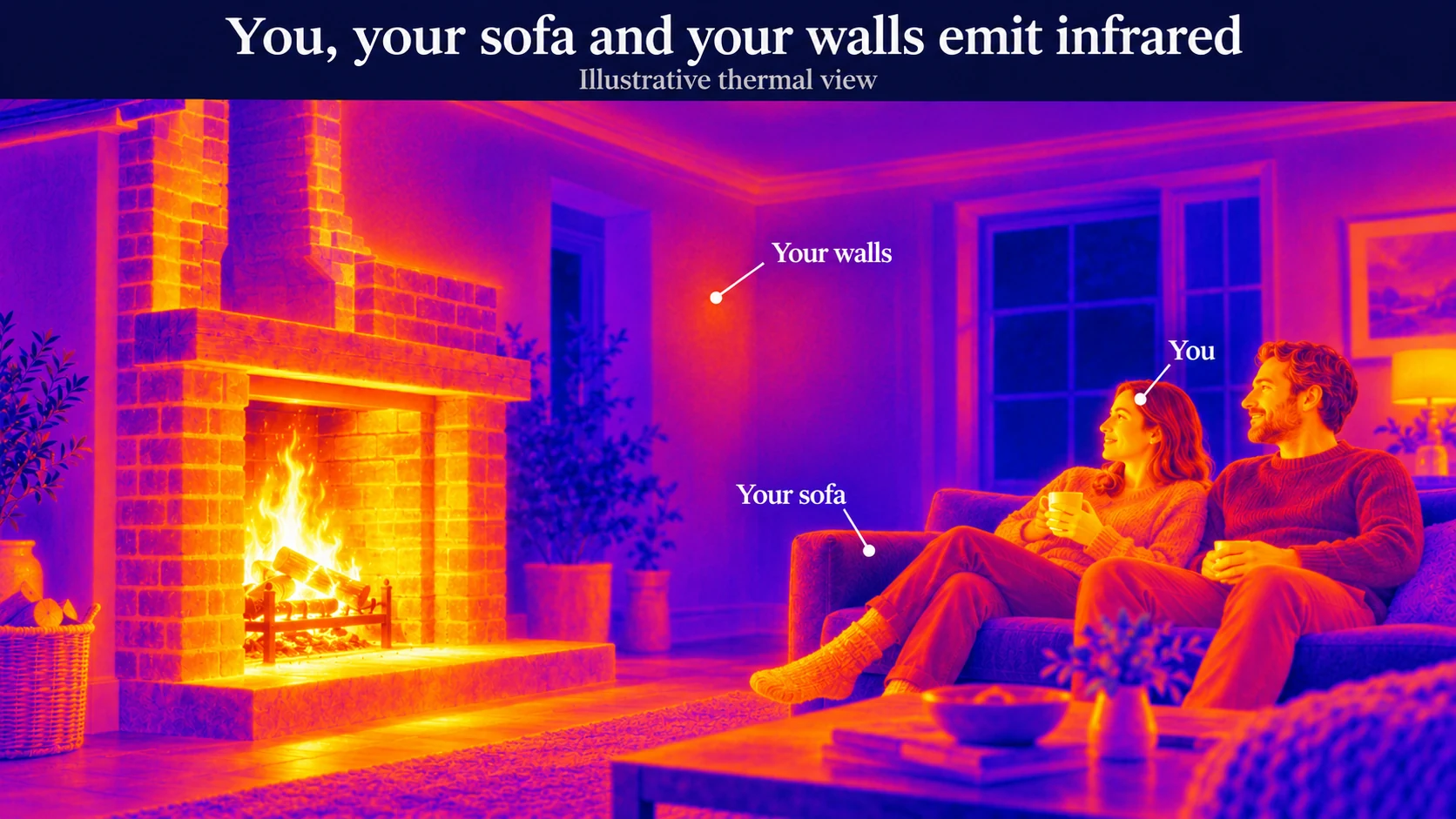
Ordinary objects around you emit thermal radiation even when they do not glow visibly. A thermal camera detects infrared and assigns display colours to reveal differences.
Those colours are chosen by the camera or operator, not colours your eyes could naturally see. Temperature estimates depend on settings, surface properties and reflections; a colourful image is not automatically a precise temperature map. [5] [6]
Warmth without relying on circulating hot air

Convector heaters warm air, creating circulation as warm air rises and cooler air moves in to replace it. Air currents can carry dust. Infrared panels deliver radiant heat directly to people and surfaces, while also producing some convection. They do not eliminate all air movement or draughts.
Warm surfaces can cushion a brief change in air temperature

Opening a door exchanges warm indoor air with cooler air. Warm walls, floors and furniture cool more slowly and continue emitting radiation. This can help maintain comfort during a brief change, but heat is still lost. Other heating systems also warm surfaces; this effect is not exclusive to infrared.
Infrared helps bond things together

Manufacturers use controlled infrared heat to dry or activate adhesives and speed up the curing of suitable heat-curable glues. The process depends on the adhesive and its required curing conditions. Industrial adhesive applications.
Infrared sends signals to your TV

Many television remotes use invisible near-infrared light to send commands to a receiver on the television. The drawn signal is an illustration, not visible light. Near-infrared is invisible to human eyes; a hot heater’s red glow is visible light emitted alongside its infrared radiation.
Familiar warmth. Thoughtful heating design.
These examples explain the physics. Choosing a heater still needs the right output, suitable controls and a layout that reaches the people and surfaces you want to warm.
Read the science guide Talk through your roomSources and illustration notes
Checked 17 October 2026. The scenic images and new explanatory graphics are original AI-generated illustrations. All diagrams are explanatory, not measurements or installation plans.
- OpenStax: mechanisms of heat transfer and radiation and net heat exchange.
- WHO: ultraviolet radiation, including exposure on snow and mountains.
- US Department of Energy: window performance, solar gain and long-wave radiation (PDF).
- Mayo Clinic: infrared saunas and the limits of current health evidence.
- NASA: infrared waves.
- FLIR: interpreting and measuring thermal images.